
Japanese verb conjugation
① The causative formTo make or let someone do something
Are you ready for a challenge?
Click here to display the vocabulary that I use in the video
| Japanese word | Rōmaji | English translation |
|---|---|---|
| 読む | yomu | to read |
| 言う | iu | to say |
| 止める | yameru | to stop |
| する | suru | to do |
| 来る | kuru | to come |
| 運転する | unten suru | to drive |
| 塾 | juku | cram school |
| 行く | iku | to go |
| 子供 | kodomo | child |
| 本 | hon | book |
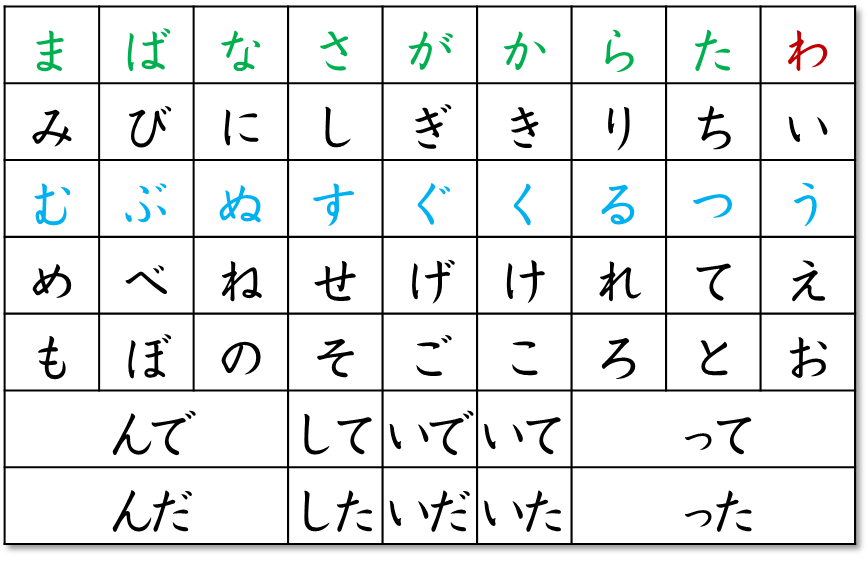
Here is the conjugation chart for the causative form of group 1 verbs:
Japanese particles
① Particles used with the causative formChoosing between に and を
With transitive verbs
With transitive verbs (those that can be used with a grammatical object, marked with the particle を), the person who does the action, actually the person who is made to do the action, is always marked with the particle に.
In short, sentences of the type Ⓐ will become sentences of the type Ⓑ at the causative form:
Ⓐ [PERSON] が [OBJECT] を [VERB]する
↓
Ⓑ [PERSON 1] が [PERSON 2] に [OBJECT] を [VERB]させる
For example:
Ⓐ 生徒 が 作文 を 書く。 ("The students write an essay.")
↓
Ⓑ 先生 が 生徒 に 作文 を 書かせる。 ("The teacher makes the students write an essay.")
With intransitive verbs
With intransitive verbs (those that cannot be used with a grammatical object), the person who does the action, actually the person who is made to do the action, can be marked with the particles に OR を, depending on a few factors.
Cases where を is the only option
✔ When we are not talking about a person. For example:
Ⓐ トマト が 腐ってしまった。 ("The tomatoes rotted.")
↓
Ⓑ トマト を 腐らせてしまった。 ("I made/let the tomatoes rot.")
✔ When we cause an emotion. For example:
Ⓐ 彼女 が 笑う/怒る/泣く。 ("She laughs/gets angry/cries.")
↓
Ⓑ 彼女 を 笑わせる/怒らせる/泣かせる。 ("I make her laugh/angry/cry.")
Cases where に is the only option
✔ When the verb is used with the particle of motion を. For example:
Ⓐ 子供 が 山道 を 歩く。 ("The children walk along the mountain path.")
↓
Ⓑ 子供 に 山道 を 歩かせる。 ("I make the children walk along the mountain path.")
Be careful, を here does not mark the grammatical object but a place where something/someone is moving. For example:
空 を 飛ぶ。 ("Fly through the sky.")
家 の 前 を 通る。 ("To pass in front of the house.")
Cases where both に & を can be used
✔ In other cases, both に & を can be used. For example:
Ⓐ 子供 が 泳ぐ。 ("The children swim.")
↓
Ⓑ 子供 を/に 泳がせる。 ("I make/let the children swim.")
Still alive? Do you want to know more about the causative form? Check out how it is used to ask for permission!